Can a Fiber Laser Cut Aluminum?
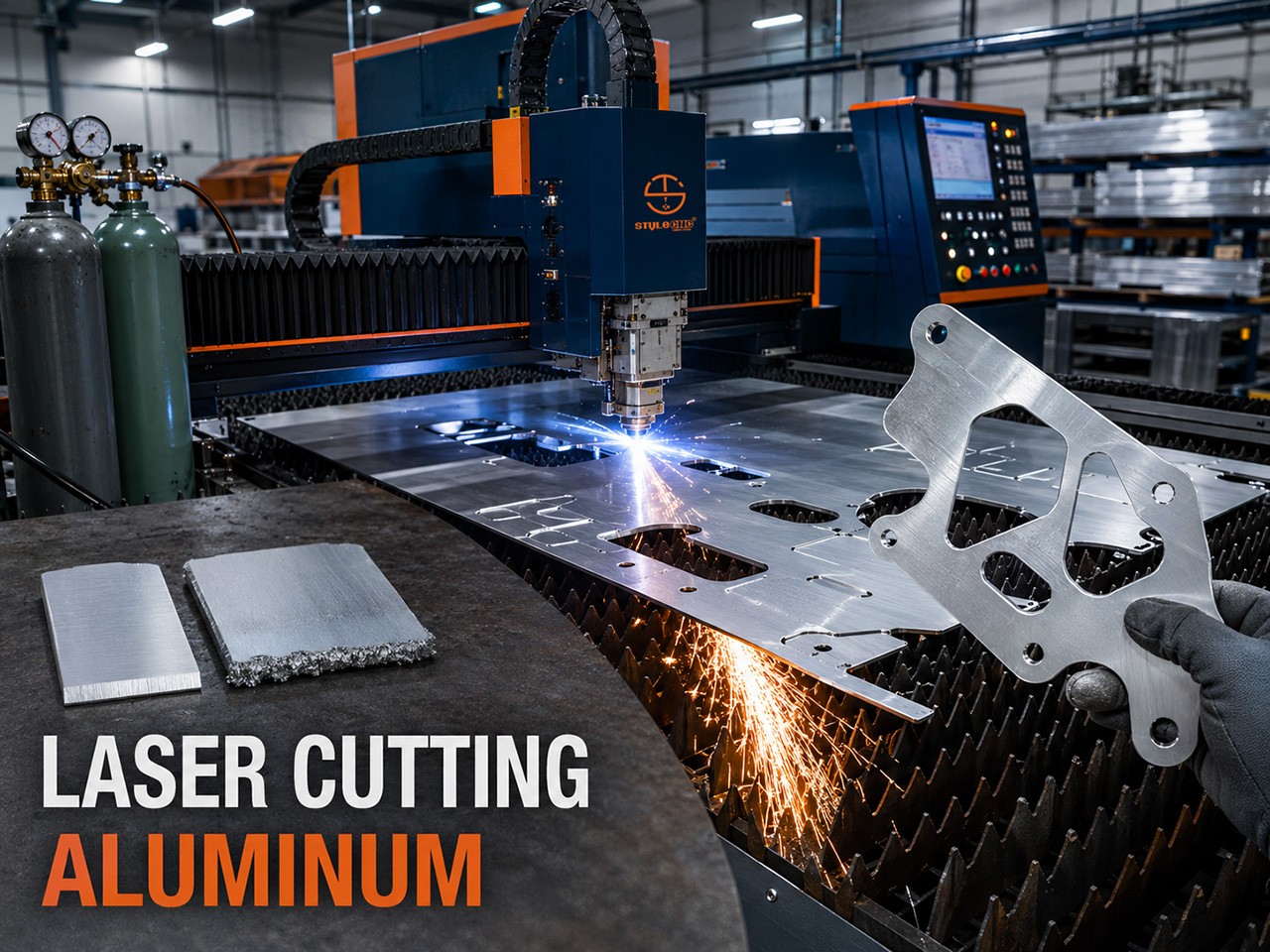
Yes, fiber lasers cut aluminum well: the 1064 nm wavelength absorbs far better in aluminum than CO2 lasers, making fiber the standard choice. A 1.5 to 2 kW fiber laser cuts up to 3 mm cleanly, 3 kW handles about 6 to 8 mm, 6 kW reaches 12 to 16 mm, and 12 kW severs up to 30 mm, though edge quality degrades above roughly 20 mm. High-pressure nitrogen assist (15 to 20 bar) is the key to dross-free edges.
The honest answer has 2 halves. Fiber lasers cut aluminum routinely, in everything from electronics enclosures to aerospace brackets to EV battery trays. And aluminum still punishes sloppy setups harder than steel does, because 2 of its material properties work directly against the physics of laser cutting.
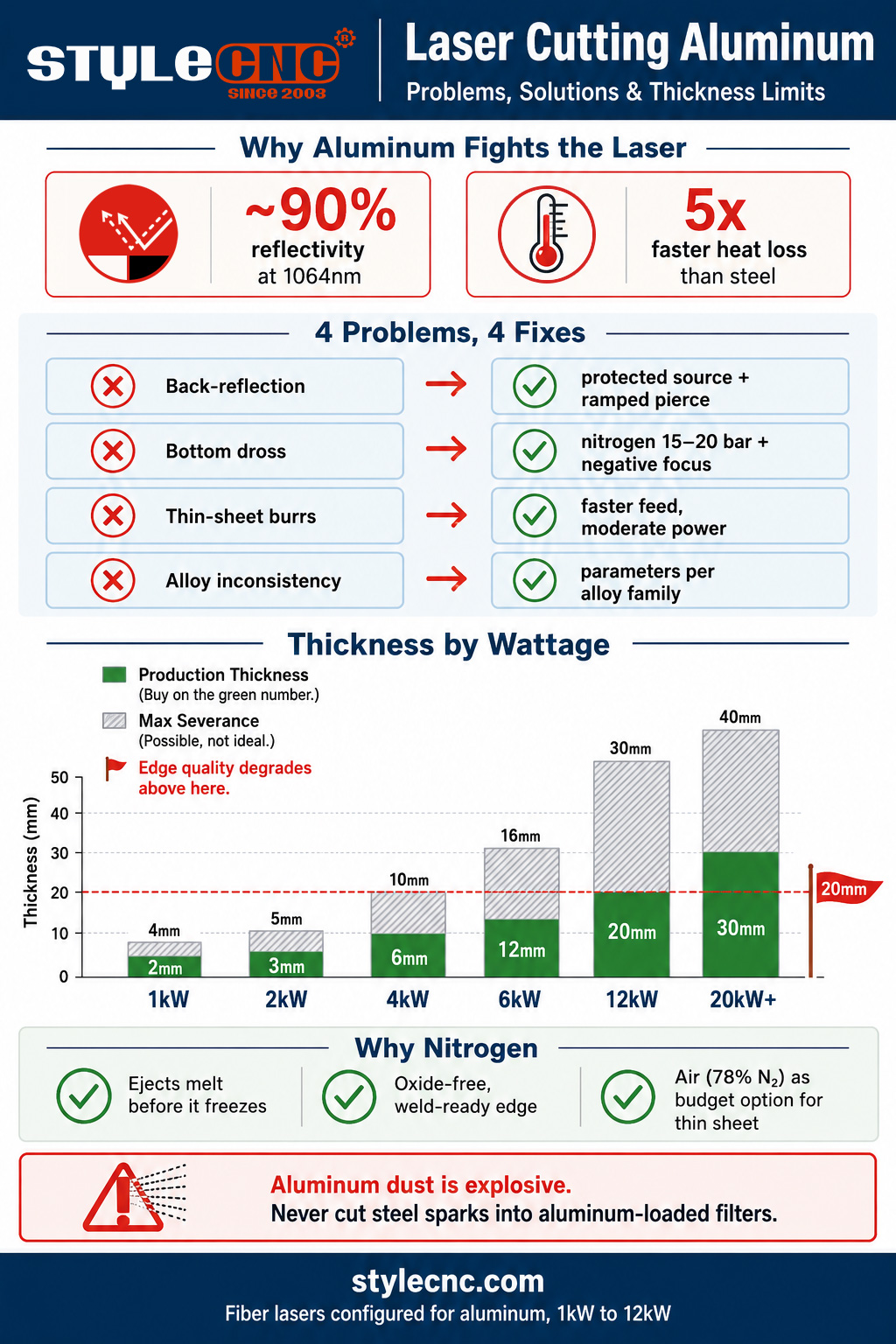
The 1st is reflectivity: aluminum reflects roughly 90 percent of the fiber laser's 1064 nm beam at room temperature, so only a fraction of the delivered power initially couples into the material. The 2nd is thermal conductivity: at roughly 237 W/m-K against about 50 for steel, aluminum drains heat out of the cut zone almost 5 times faster. The beam is fighting to build a melt pool while the surrounding sheet actively cools it. Everything difficult about laser cutting aluminum traces back to those 2 numbers.
The 4 Problems That Ruin Aluminum Cuts (and Their Fixes)
PROBLEM 1: Back-Reflection
Quid fit?: Uncut aluminum acts like a mirror at 1064 nm. During piercing, before the melt pool forms, a portion of the beam reflects straight back up the optical path. On unprotected machines this can damage the cutting head optics or, in severe cases, the laser source itself, which is why older sources carried aluminum warnings in their manuals.
In fix: Modern fiber lasers ship with back-reflection protection (isolators and sensors that fault the source before damage). Confirm your source is rated for reflective metals, keep the head perpendicular so reflections do not focus back cleanly, and use a proper piercing routine (ramped power, slight defocus) so the mirror phase lasts milliseconds instead of seconds.
PROBLEM 2: Dross on the Bottom Edge
Quid fit?: The defining aluminum defect. Molten aluminum is viscous, and the sheet's high conductivity cools the melt so quickly that it turns slushy before the assist gas can eject it. The half-solidified metal clings to the bottom of the kerf and freezes into a hard, sharp bead that must be ground off. Thicker sheet makes it worse: more melt volume, same escape window.
In fix: Ejection beats power. Run high-pressure nitrogen at 15 to 20 bar through a larger nozzle, set the focus negative (into the material) so the kerf stays wide at the bottom and gives the melt an exit, and slow the feed 10 to 15 percent from steel-equivalent settings. If dross persists, fix gas, nozzle, standoff, and focus before reaching for more wattage; extra power on a poorly ejected cut just makes more melt to clean off.
PROBLEM 3: Burrs and Rough Edges on Thin Sheet
Quid fit?: On sheet under 3 mm the usual cause flips: too much heat, not too little. Excess power or slow feed overheats the soft alloy, the kerf edges melt back, and the cut exits with a raised burr and a striated, gray edge instead of a clean bright face.
In fix: Cut thin aluminum fast with moderate power and clean nitrogen. Verify nozzle condition and centering (a worn or off-center nozzle drags gas flow sideways and burrs one side of the kerf), and keep focus at or just below the surface for maximum edge crispness. Well-tuned thin-sheet aluminum should come off the table bright, burr-free, and ready for the brake.
PROBLEM 4: Inconsistent Results Between Alloys
Quid fit?: Operators tune parameters on one job and get dross on the next because aluminum is not one material. Pure 1xxx series cuts easily but drosses heavily. 5xxx marine grades cut the cleanest of the common alloys. 6xxx architectural extrusion demands careful speed control to avoid burning, and high-strength 7xxx aerospace plate is the most parameter-sensitive and crack-prone of all.
In fix: Store parameters per alloy family, not one aluminum setting. When a new alloy or even a new batch arrives, run a short test cut and re-tune speed and pressure before committing the sheet. The 15 minutes of test cuts cost less than one scrapped nest.
Aluminum Laser Cutting Thickness Chart by Wattage
The single most important distinction in any thickness claim is maximum severance versus production thickness. Maximum severance means the beam gets through, slowly, with edge quality that may need rework. Production thickness means stable speed, clean edges, and repeatability. Buy and quote against the production number.
| Laser virtutis Dei | Production Thickness | Maximum Severance | Notes |
|---|---|---|---|
| kW 1 | Ut 1 mm 2 | Ut 3 mm 4 | Thin sheet, signage, enclosures. Clean and fast in its window |
| 1.5 ad III kW | Ut 2 mm 3 | Ut 4 mm 5 | The entry point for reliable aluminum production work |
| kW 3 | Ut 4 mm 6 | Ut 8 mm 10 | Sweet spot for general fabrication and job shops |
| kW 6 | Ut 8 mm 12 | 16 mm | Covers most aluminum applications adequately |
| kW 12 | Ut 12 mm 20 | Ut 25 mm 30 | Edge quality degrades noticeably above ~20 mm |
| 20 kW+ | Ut 20 mm 30 | 40 mm+ | Plate work; deep negative focus (-8 to -15 mm) required |
2 physics notes explain why the table flattens at the top. Power-to-thickness scaling is sub-linear: doubling wattage raises usable thickness by roughly half, not double, because the exponent in the power-thickness relationship sits around 0.65 for laser cutting. And on thick aluminum specifically, the sheet's conductivity turns it into a heat sink: extra wattage spreads sideways into the surrounding metal and enlarges the melt pool faster than it deepens the cut, which is why pushing power into a drossy thick-plate cut usually thickens the dross instead of cleaning it.
For the general-metal picture across steel, stainless, and aluminum at each power level, the fiber laser cutting thickness, speed, and power reference carries the full multi-material tables that this aluminum-specific chart slots into.
Why Nitrogen Assist Matters for Aluminum
Assist gas does 2 jobs in laser cutting: it ejects molten metal from the kerf, and it controls the chemistry at the cut face. On aluminum, both jobs point to nitrogen.
✓ Ejection under pressure: Aluminum's fast-cooling melt needs to leave the kerf before it turns slushy. Nitrogen at 15 to 20 bar through a larger-diameter nozzle provides the mechanical blast that clears the melt in its brief liquid window. This is the single biggest lever on dross.
✓ An inert cut face: Oxygen assist, standard on carbon steel, reacts with aluminum to form hard aluminum oxide in and around the kerf, roughening the edge and complicating any later welding or anodizing. Nitrogen keeps the cut face bright, oxide-free, and weld-ready straight off the table.
✓ No combustion help anyway: Oxygen earns its place on carbon steel by contributing exothermic energy to the cut. Aluminum offers no such bonus worth the oxide penalty, so the oxygen trade is all downside.
✓ Compressed air as the budget middle: Air is roughly 78 percent nitrogen, and modern high-pressure air systems cut thin and medium aluminum acceptably at a fraction of bottled-nitrogen cost. Expect a slight gray tint on the edge from partial oxidation. For signage and general fabrication it passes; for weld-prep and anodize-bound parts, stay on nitrogen.
The practical cost note: nitrogen consumption rises steeply with pressure and nozzle size, which is exactly the aluminum recipe. Shops cutting aluminum daily typically justify a nitrogen generator faster than steel-only shops do, and the air-assist option is worth qualifying on real parts before assuming bottled gas is the only path.
The Safety Note Nobody Should Skip: Aluminum Dust
Fine aluminum powder is explosive, and laser cutting generates it. The hazard is not the cutting itself but the dust collection system: aluminum fines accumulating in filters create a fuel load, and the classic accident scenario is cutting steel, whose sparks act as the ignition source, into an extraction system already loaded with aluminum dust.
The protective rules are simple. Keep the dust system clean on an actual schedule, never mix steel sparks into aluminum-loaded filters (segregate the work or clean between material changes), and follow the extraction manufacturer's guidance on wet separators or spark arrestors where aluminum volume is high. Every fiber laser shop cutting aluminum at production volume should treat this as a standing procedure, not tribal knowledge.
STYLECNC Fiber Lasers for Aluminum
STYLECNC fiber laser cutting machines ship with the configuration aluminum demands: back-reflection-protected sources rated for reflective metals, high-pressure assist gas circuits for 15 to 20 bar nitrogen work, and cutting parameter libraries with per-alloy aluminum settings. The best fiber laser metal cutting machine line covers the 1.5 to 6 kW range where most aluminum fabrication lives, and the sheet metallum laser circumdatos configuration targets the thin-and-medium sheet work that dominates enclosures, signage, and panel production.
For shops pushing into thick plate, the Machina secandi metallum fibrae laseris magnae potentiae scales into the 12 kW class where 20 mm production aluminum becomes realistic. And for a ground-truth look at entry-level capability, the 1000W IPG fiber laser cutting 3 mm aluminum video shows exactly what the bottom row of the thickness chart looks like on real material. Contact the STYLECNC team with your alloys, thickness range, and monthly volume for a configuration and gas-system recommendation matched to aluminum work.
Frequenter Interrogata De quaestionibus
Can a fiber laser cut aluminum without damaging itself?
Yes, on any modern machine. The historical fear comes from aluminum's roughly 90 percent reflectivity at the fiber wavelength: during piercing, the uncut surface reflects beam energy back up the optics, and early unprotected sources could be damaged. Current fiber sources ship with back-reflection isolation and sensors that fault safely, which is why aluminum is now a routine production material. Confirm the source's reflective-metal rating before buying, then cut with confidence.
Why is there dross on my aluminum laser cuts?
Because aluminum's melt cools too fast to escape. The sheet conducts heat away at roughly 5 times the rate of steel, so molten metal turns slushy in the kerf and freezes onto the bottom edge before the gas ejects it. The fix order that works: raise nitrogen pressure toward 15 to 20 bar, fit a larger nozzle, push focus deeper (negative) into the material, and slow feed 10 to 15 percent. Add power only after ejection is right; more wattage on a poorly ejected cut just makes more dross.
How thick can a laser cut aluminum?
By power class, in production terms: 1 kW handles 1 to 2 mm, 3 kW about 4 to 6 mm, 6 kW roughly 8 to 12 mm, and 12 kW runs 12 to 20 mm with maximum severance near 30 mm. Above roughly 20 mm, edge quality degrades regardless of power because aluminum's conductivity spreads the beam energy sideways into the sheet faster than it deepens the cut. Quote jobs on production thickness, not the brochure severance number.
Do I need nitrogen to laser cut aluminum?
For clean, weld-ready, anodize-ready edges, yes: high-pressure nitrogen ejects the melt and keeps the cut face oxide-free, and oxygen actively hurts aluminum by forming hard oxide on the edge with no combustion benefit in return. The budget alternative is high-pressure compressed air, which is 78 percent nitrogen and cuts thin-to-medium aluminum acceptably with a slight gray edge tint. Signage and general fabrication can run air; weld-prep and cosmetic work should stay on nitrogen.
numquid potest, CO2 laser cut aluminum?
Poorly, and it is not recommended. Aluminum reflects the CO2 laser's 10.6 micron wavelength even more strongly than the fiber wavelength, so coupling is worse, back-reflection risk is higher, and the practical thickness window is thin. This is a of the main reasons metal fabrication moved decisively to fiber sources: the 1064 nm beam absorbs several times better in aluminum, turning a marginal CO2 process into a routine fiber one.
Why do different aluminum alloys cut so differently?
Alloy chemistry changes melt behavior. Pure 1xxx series aluminum cuts easily but produces the heaviest dross. 5xxx marine grades are the clean-cutting favorites. 6xxx architectural alloys need disciplined speed control to avoid burning, and 7xxx aerospace plate is the most parameter-sensitive and crack-prone family. Batch-to-batch variation adds another layer even within one grade. The working answer is a parameter library per alloy family and a quick test cut whenever new material lands.
Solum Versus
Aluminum cuts beautifully on fiber lasers once the setup respects its 2 defining properties. Reflectivity is solved by protected modern sources and disciplined piercing. Conductivity, the root of dross and the thickness ceiling, is solved by ejection: high-pressure nitrogen, the right nozzle, negative focus, and honest speed. Match wattage to the production-thickness column rather than the severance claim, keep parameters per alloy, and keep the dust system clean.
STYLECNC configurat fibra laser sectione machinis for aluminum work from 1 kW sheet cutters to 12 kW plate systems, with the gas circuits and parameter libraries the material demands. Send the STYLECNC team your thickness range and alloys for a recommendation grounded in the numbers above.